


Autor: Tomislav Brenko, M. geol.
Based on long term systematically field examinations of Ivan and Zlatko Zvijerac from Torčec, Josip Cugovčan from Podravske Sesvete, late Miralem Alečković from Hlebine, Ranko Pavleša from Starigrad and employees of the Museum of Koprivnica, over the last 30 years numerous archaeological sites were found in the Podravina region and dated to Late Antique and Middle Ages were discovered. Countless fragments of iron slags pointed to existence of a greater number of iron production sites in Antique and Middle Ages throughout the low-lying Drava River (Sekelj Ivančan and Marković, 2017; Valent et al., 2017). Main problem lies in the fact that up to now no significant iron ore deposits were recognized or discovered in the Podravina region that could justify the existence of such iron culture in this area. However, it is assumed that that the locally mined bog iron ore was used as the main material for the iron production.
Bog iron ore is a sedimentary accumulation of iron oxides and hydroxides inside soils, swamps, lakes and in vicinity of smaller creeks (Stanton et al., 1972; Landuydt, 1990). It is divided into three main macromorphological types, that also represent development phases; in the form of soft, earthy iron accumulations in soil, harden concretional and nodular shapes and in the form of iron layers (Figure 1). Bog iron ore is mainly found in flatten glacial valley, where smaller creeks and slower rivers flow (Stoops, 1983; De Geyter, 1985; Kaczorek and Sommer, 2003; Thelemann et al., 2017). Wide occurences of this type of iron ore are found in the Central Europe, inside alluvial sediments, sandy and clayey soils, often in horizons with significant biological activity (Kaczorek et al., 2009). Main components of this type of ore are iron and manganese oxyhydroxides. Manganese oxyhydroxides are characterized by their darker grey-blackish colour, while the iron occurrences are characterized by brownish-red colours. It is widely accepted that the majority of bog iron ores are located in areas with high groundwater levels and in soils with no visible outer structure. As mentioned, in Central Europe bog iron are connected with alluvial sands, silty and clayey soils, often in organic-rich layers, and in marginal, sandy parts of swamp lowlands (Landuydt, 1990; Kaczorek et al., 2004).
Up until now, the area of the Podravina region was not recognized as a perspective area where bog iron ore precipitation occurred. The first step in order to determine if Podravina is a suitable area is to conduct detailed mineralogical and geochemical analyses of the main soil types. By conducting these analyses, occurrence of iron minerals in the soils, as well as the possibility for iron ore formation will be established. Based on that, six soil profiles were chosen for the analyses. Inside the soil profiles, signs of iron occurrences were detected, which in combination with observation on the groundwater fluctuation referred on the possibility of bog iron ore formation in the area of the Podravina region.
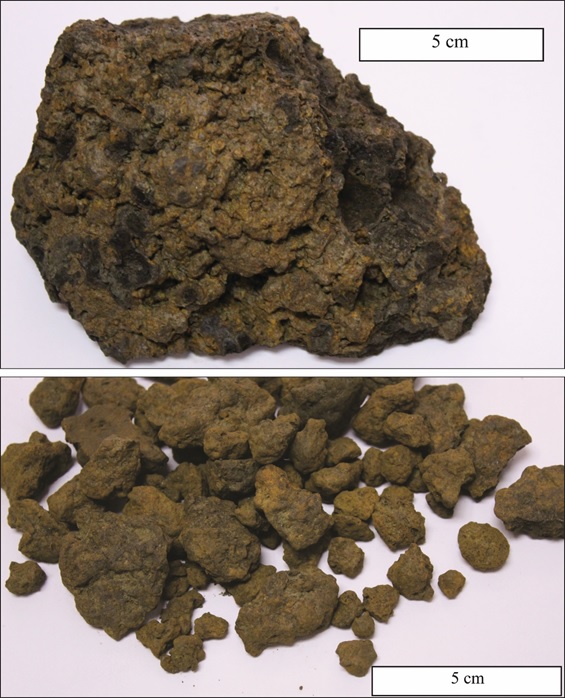
Figure 1 Bog iron ore samples found in the Podravina region
In the terms of observing their mineralogical and geochemical characteristics, bog iron ores as of yet were not analysed. Based on the fact that there were no clear archaeological evidence of bog iron ore usage and exploitation in the area, detailed analyses of bog iron ore characteristics were required in order to determine bog iron role in Podravina region iron culture. Besides soils, mineralogical and geochemical analyses were conducted on numerous bog iron samples, roasted iron ore samples and iron slags. Detailed analysis using scanning electron microscopy (SEM-EDS) shows a laminated structure inside the bog iron ore, as a clear result of seasonal changes and groundwater fluctuations during ore formation (Figure 2).

Figure 2 SEM-EDS analysis on the samples of bog iron ore with clearly visible lamination pattern of Fe- and Mn-oxyhydroxides
Detaljnim geokemijskim korelacijama i statističkim analizama nastoji se utvrditi veza između uzoraka močvarne željezne rude pronađenih na nekoliko lokaliteta i arheoloških uzoraka željezne zgure pronađene na brojnim lokalitetima u Podravini. Prije svega, promatra se ponašanje elemenata rijetkih zemalja (REE) koji se mogu prikazati u obliku tzv. Spider dijagrama gdje dobivamo njihov geokemijski otisak, specifičan za područje i uvjete u kojem promatrani uzorci nastaju (Slika 3). Praćenjem i usporedbom takvih geokemijskih otisaka može se jednoznačno povezati uzorke rude i arheološki pronađenih predmeta. S obzirom na navedeno, očekuje se da će se navedenim istraživanjem nedvojbeno odrediti izvorišni materijal za jednu, do sada zanemarenu željeznu kulturu u ovom dijelu Hrvatske, kao i usporediti močvarnu željeznu rudu sa prostora Podravine sa drugim tipovima rude u svijetu.
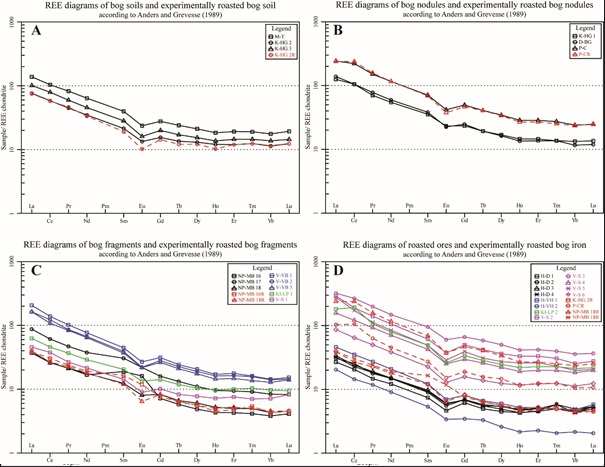
Figure 3 Rare earth element diagrams for samples of bog iron soils, nodules, fragments and roasted iron ores
Reference:
De Geyter, G., Vandengerghe, R.E., Verdonck, L., Stoops, G., 1985. Mineralogy of holocene bog-iron ore in northern Belgium. Neues Jahrb. für Mineral. Abh. 153, 1–17.
Kaczorek, D., Brummer, G.W., Sommer, M., 2009. Content and binding forms of heavy metals, aluminum and phosphoruis in bog iron ores from Poland. J. Environ. Qual. 38, 1109–1119.
Kaczorek, D., Sommer, M., 2003. Micromorphology, chemistry and mineralogy of bog iron ores from Poland. Catena 54, 393–402.
Kaczorek, D., Sommer, M., Andruschkewitsch, I., Oktaba, L., Czerwinski, Z., Stahr, K., 2004. A comparative micromorphological and chemical study of „Rasseneisenstein “(bog iron ore) and „Ortstein“. Geoderma 121, 83–94.
Landuydt, C.J. 1990. Micromoprhology of iron minerals from bog ores of the Belgian Campine area. Developments in Soil Science 19, 289–294.
Sekelj Ivančan, T., Valent, I. 2017, Ostaci talioničke radionice na lokalitetu Hlebine–Velike Hlebine, Annales Instituti Archaeologici 13, 73–76.
Stoops, G., 1983. SEM and light microscopic observations of minerals in bog-ores of the Belgian Campine. Geoderma 30, 179–186.
Thelemann, M., Bebermeier, W., Hoelzmann, P., Lehnhardt, E., 2017. Bog iron ore as a resource for prehistoric iron production in Central Europe – A case study of the Widawa catchment area in eastern Silesia, Poland. Catena 149, 474–490.
Valent, I., Zvijerac, I., Sekelj Ivančan, T., 2017. Topografija arheoloških lokaliteta s talioničkom djelatnošću na prostoru Podravine. Podravina 16/32, 5–25.
_________________________________________________________________________________
Tomislav Brenko, M. geol. is a doctoral student at the Department of Mineralogy, Petrology and Mineral Resources at the Faculty of Mining, Geology and Petroleum Engineering, University of Zagreb. He is currently conducting a doctoral study entitled „Mineralogical and geochemical link between the bog iron ore deposits and preindustrial slags throughout the lowland Drava area“.
E-portfolio https://moodle.srce.hr/eportfolio/user/view.php?id=5197
ResearchGate https://www.researchgate.net/profile/Tomislav_Brenko
Google Scholar https://scholar.google.com/citations?user=t7g7TPEAAAAJ&hl=en