


Marija Pejić, mag.geol.
GEOlogical characterization of the Eastern part of the Drava depression subsurface intended for the evaluation of Energy Potentials (GEODEP) project started in February 2020 and will last until February 2025. It is funded by the Croatian Science Foundation and it involves 10 researchers and two associates. In addition to employees and one student from the Faculty of Mining, Geology and Petroleum Engineering, two researchers are employers of the Croatian Geological Institute. The main aim of the project is to create a geological model of subsurface in the eastern part of Drava Depression. The model will be used for estimation of the hydrocarbon potential and geological storage of CO2 potential. Within the project, testing of equipment and methods for locating hydrocarbon migration pathways (faults) in the underground was carried out, which took place near city of Kutina, in the area of the Sava Depression.
The method we wanted to test was soil gas monitoring, which has numerous exploration applications including soil contamination by anthropogenic factors (Chylkova et al,2009; Hendel, 2017), health risk from radon concentration in urban planning (Cinelli et al, 2015; Tokonami, 2020), earthquake prediction (Sugisaki et al, 1983) and mineral and hydrocarbon resource exploration (Partington, 1957; Füst& Geiger, 2010). Radon and thoron are interesting to monitor because of their ratio. Mainly two radioisotopes of radon are present in nature, 222Rn and 220Rn (thoron). 222Rn has half-life of 3.8 days, while thoron has half-life of 55.6 s (Jönsson, 1995). Radon (222Rn) is produced by radioactive decay of radium (226Ra), as a part of uranium (238U) decay chain, while thoron is produced by radioactive decay of 224Ra in thorium (232Th) decay chain. Due to the above, their ratio may indicate whether the gas being detected arrived by migration from greater depths or is of local origin. Carrier gas transport could be the reason for the non-diffusive radon transport (Kristiansson&Malmqvist, 1982) ,so the non-reactive radon represents a suitable tracer for gas transport from the deeper subsurface to the surface. Carbon dioxide and methane are considered potential carrier gases for radon (Durrance&Gregory, 1990; Etiope&Lombardi, 1995) which is why their concentrations were also measured. The seepage of methane and other hydrocarbons along faults and fractures from hydrocarbon bearing formations is recognized worldwide (Khilyuk et al, 1990; Dyck&Jonasson, 2000). Number of authors stated that it is possible to define active faults by measuring radon concentrations over the study area through anomalies which indicate more emissive zones related either to main faults or secondary fractures (Aubert&Baubron, 1988; Neri et al, 2019; Palacios et al, 2013).
Several soil gas parameters were measured at two different sites. These included the radon (222Ra), thoron (220Ra), CO2, CH4, PID (photoionization detector - volatile organic compound), and TP (total petroleum - volatile hydrocarbon component) concentrations. Since radon concentrations are very variable and it is difficult to conclude which parameters affect it, measurements of natural radioactivity were also performed. The purpose of measuring natural radioactivity was to be able to confirm that the increased radon concentrations were not caused by shallow subsurface geological diversity.
Measurements were taken at two sites (Figure 1). The first was selected based on known locations of oil seepage at the surface (site A) and the second because of known hydrocarbon accumulation in the subsurface (site B).

Figure 1 Location map showing the broader area of exploration and locations of Site A and Site B along with oil and/or gas fields. DEM overlay acquired from https://land.copernicus.eu/homepage-content/eu_dem.png/view (Cvetković et al, 2021).

Three different instruments were used in this research (Figure 2). SARAD RTM 2200 is a radon and thoron measurement system that can also measure soil permeability, temperature and humidity. ECOPROBE 5 measures CO2 and CH4 concentrations, volatile organic compounds, and other volatile hydrocarbon components. Its main applications are fast mapping and monitoring of contaminated areas and identifying the contaminant sources and migration paths. The Gamma Surveyor Vario with the VB6 BGO probe is a geophysical gamma-ray spectrometer that is used for the determination of the concentrations of K [%], U [ppm] and Th [ppm] as well as the natural gamma dose rate [nGy/h or nSv/h].
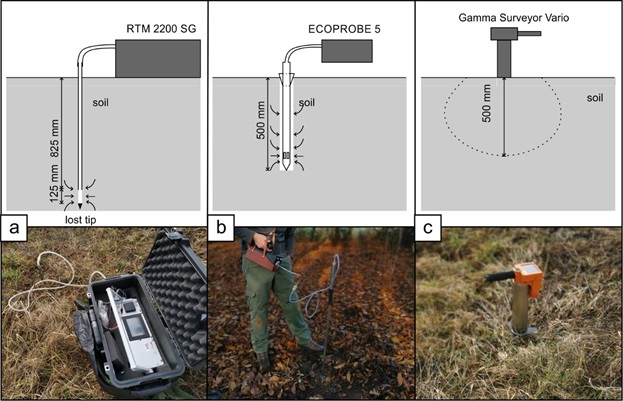
Figure 2. (a) Sarad RTM 2200; (b) ECOPROBE 5; and (c) Gamma Surveyor Vario measuring principles (Cvetković et al, 2021).
The fault with a SW–NE orientation represents a boundary between predominantly marl west of the fault and the mixed marl-sandstone lithology east of the fault. The dose rate (DR) was increased in the western area in correspondence to the clay content in the marls. Lower values of U, Th, and DR were registered in the SE area of Site A where sandstone outcrops were observed. Locally, lower values of all three elements and DR were observed around the oil seepage and oil mine. Increases in concentration of volatile organic compound were identified east of the fault and east of the oil seepage and oil mine. Volatile hydrocarbon component values were only recorded near the seepage. Elevated radon concentrations were recorded in the area near the fault (Figure 3a), but were generally very variable within Site A. Distribution of the radon/thoron ratio showed a clear anomaly in the area near the oil seepage (Figure 3c).
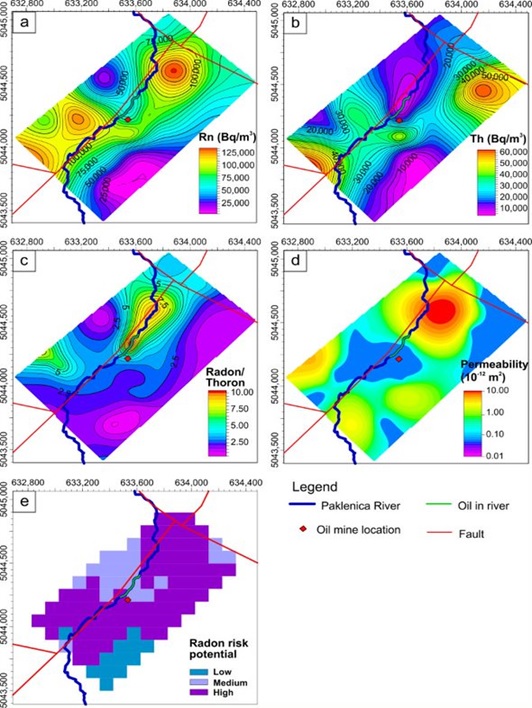
Figure 3. Radon (a); thoron (b); radon/thoron ratio (c); and permeability distribution (d) within Site A (Cvetković et al, 2021).
Site B was selected to test the applicability of using soil gas measurements to detect hydrocarbon seepage from underlying accumulation areas. Some of the sampling points selected were located above known production fields, while others were positioned in areas with no evidence of existing accumulation. Volatile hydrocarbon component values were recorded only in the area over production fields. CH4 concentration above 50 ppm was only recorded at one location, which was also within the boundaries of the oil producing field. Radon concentrations were generally elevated in hydrocarbon producing fields area. Volatile hydrocarbon component values increased from the predominantly gas-bearing field (Lipovljani, Figure 1, lip-2 and 3), to the mixed oil and gas field Jamarica (lip-4 and 5), to the predominantly oil-bearing field Kozarice (Figure1, lip-6).
The results show correlations of radon, thoron, CO2, and hydrocarbon concentrations in soil gas with the occurrence of oil seepage on the surface and proven hydrocarbon accumulation in the subsurface. Radon/thoron ratios at Site A indicate a migration pathway from the deeper subsurface through elevated concentrations of the longer half-life 222Rn (radon) relative to the shorter half-life 220Rn (thoron) in soil gas. The same type of measurements will take place in some interesting areas.of the eastern part of Drava depression.
References:
Aubert, M. and Baubron, J.C., 1988. Identification of a hidden thermal fissure in a volcanic terrain using a combination of hydrothermal convection indicators and soil-atmosphere analysis. Journal of volcanology and geothermal research, 35(3), pp.217-225.
Chylkova, J., Machalikova, J., Obrsalova, I., Brunclik, T. and Bata, R., 2009. Monitoring of methane and CO2 from selected sources in the environment in the Czech Republic. Recent Advances in Environment, Ecosystems and Development, pp.96-103.
Cinelli, G., Tositti, L., Capaccioni, B., Brattich, E. and Mostacci, D., 2015. Soil gas radon assessment and development of a radon risk map in Bolsena, Central Italy. Environmental geochemistry and health, 37(2), pp.305-319.
Cvetković, M., Kapuralić, J., Pejić, M., Kolenković Močilac, I., Rukavina, D., Smirčić, D., Kamenski, A., Matoš, B. and Špelić, M., 2021. Soil gas measurements of radon, CO2 and hydrocarbon concentrations as indicators of subsurface hydrocarbon accumulation and hydrocarbon seepage. Sustainability, 13(7), p.3840.
Durrance, E.M. and Gregory, R.G., 1990. Helium and radon transport mechanisms in hydrothermal circulation systems of Southwest England. In Geochemistry of gaseous elements and compounds (pp. 337-352).
Dyck, W. and Jonasson, I.R., 2000. Radon. In Handbook of Exploration Geochemistry (Vol. 7, pp. 353-394). Elsevier Science BV.
Etiope, G. and Lombardi, S., 1995. Evidence for radon transport by carrier gas through faulted clays in Italy. Journal of Radioanalytical and Nuclear Chemistry, 193(2), pp.291-300.
Füst, A. and Geiger, J., 2010. Monitoring planning and evaluation using geostatistics, I. Geostatistical support for verification sampling based on professional opinion (In Hungarian). Földani Közlöny, 140, pp.303-312.
Hendel, J., 2017. Occurrence of microbial and thermogenic gases in post-mining areas. International Multidisciplinary Scientific GeoConference: SGEM, 17(1.1), pp.393-398.
Jönsson, G., 1995. Radon gas—where from and what to do?. Radiation measurements, 25(1-4), pp.537-546.
Kristiansson, K. and Malmqvist, L., 1982. Evidence for nondiffusive transport of 86 Rn in the ground and a new physical model for the transport. Geophysics, 47(10), pp.1444-1452.
Neri, M., Giammanco, S. and Leonardi, A., 2019. Preliminary indoor radon measurements near faults crossing urban areas of Mt. Etna volcano (Italy). Frontiers in public health, 7, p.105.
Palacios, D., Fusella, E., Avila, Y., Salas, J., Teixeira, D., Fernández, G., Salas, A., Sajo-Bohus, L., Greaves, E., Barros, H. and Bolívar, M., 2013. Radon measurements over a natural-gas contaminated aquifer. Radiation measurements, 50, pp.116-120.
Partington, J.R., 1957. Discovery of radon. Nature, 179(4566), pp.912-912.
Sugisaki, R., Ido, M., Takeda, H., Isobe, Y., Hayashi, Y., Nakamura, N., Satake, H. and Mizutani, Y., 1983. Origin of hydrogen and carbon dioxide in fault gases and its relation to fault activity. The Journal of Geology, 91(3), pp.239-258.
Tokonami, S., 2020. Characteristics of Thoron (220Rn) and Its Progeny in the Indoor Environment. International Journal of Environmental Research and Public Health, 17(23), p.8769.
_________________________________________________________________________________
Marija Pejić, mag geol., is a junior researcher - assistant hired on the GEODEP project (GEOlogical characterization of the Eastern part of the Drava depression subsurface intended for the evaluation of Energy Potentials) and a phD student at the Faculty of Mining, Geology and Petroleum Engineering in Zagreb. The focus of her doctoral research is on surface methods that can potentially improve underground geological models.
E-portfolio https://moodle.srce.hr/eportfolio/user/view.php?id=51612
ResearchGate https://www.researchgate.net/profile/Marija-Pejic
Google Scholar https://scholar.google.com/citations?user=iz0Z4_AAAAAJ&hl=en&oi=ao
CROSBI https://www.bib.irb.hr/pretraga?operators=and|Peji%C4%87,%20Marija%20%2838882%29|text|profile